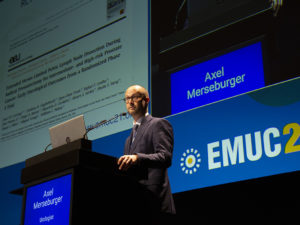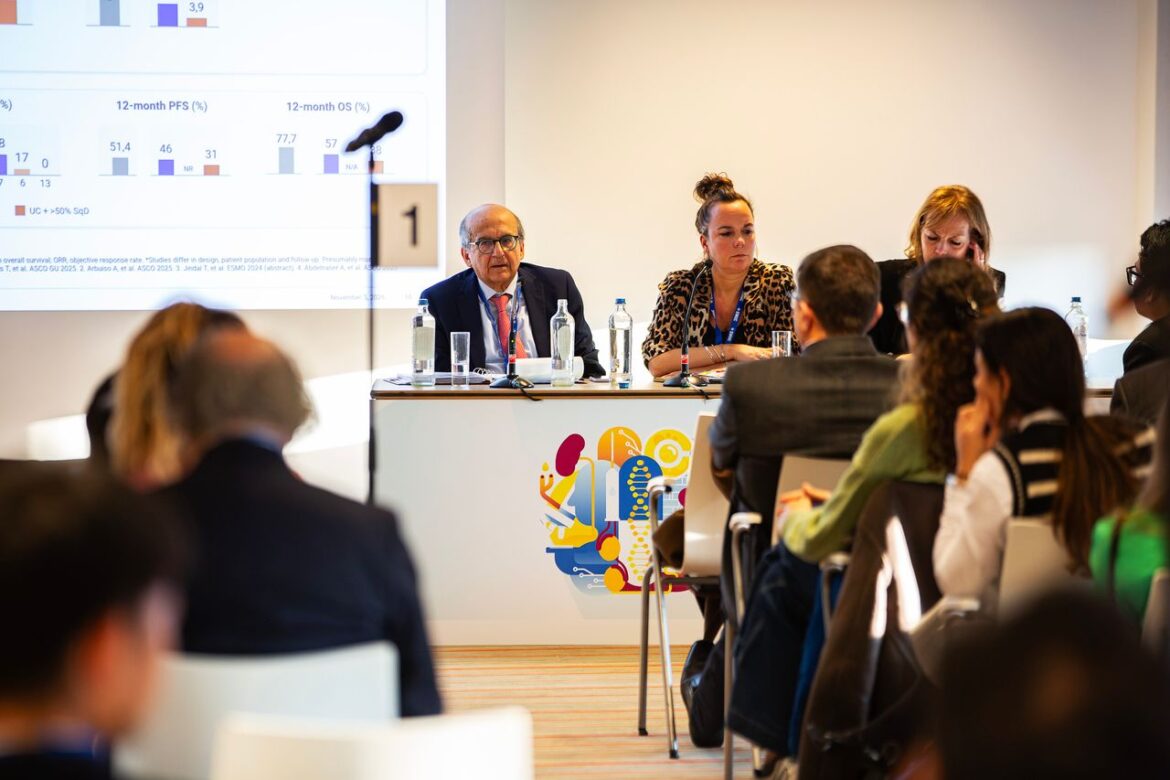
Expert pathologists, radiologists, urologists, and medical oncologists presented and discussed current perspectives and future directions on urological pathology at the European Society of Uropathology – EAU Section of Urological Research (ESUP-ESUR) Symposium held during EMUC26 today. Sessions included the current perspective on adjuvant therapy after nephrectomy, advances in the diagnosis of muscle-invasive bladder cancer (MIBC), and the emerging role of biomarkers in genitourinary (GU) pathology. The session was chaired by Prof. Maurizio Colecchia (IT), Dr. Clémentine Le Magnen (CH) and Dr. Maria Raspollini (IT).
miRNA in testis tumours
Dr. Nicola Nicolai (IT) presented on ‘The emerging role of miRNA in testis tumours’. He began with “The question is not if the biomarker works, but how it works at different stages of patient management. The clinical validity is setting-specific: a test can be ready for one question and not for another”.
To illustrate this, his presentation followed the patient journey including how does miRNA perform for assessing whether a testicular mass is a germ cell tumour (GCT), detecting occult disease following orchiectomy, monitoring for recurrence during surveillance, identifying viable tumour in retroperitoneal lymph nodes or residual mass, and guiding risk-adapted treatment to improve clinical outcomes.
According to Dr. Nicolai, miR-371 is an excellent diagnostic marker that is currently the best biomarker for detecting GCT, but it is an imperfect clinical biomarker. Key pre-analytical and analytical challenges include the lack of inter-laboratory standardisation, differences between serum and plasma samples, sample handling and RNA degradation, timing of sample collection due to the rapid clearance of miR-371 and limitations of RT-qPCR assays. Furthermore, its prognosis value remains limited as miR-371 is teratoma blind and has a weak prognostic value to predict aggressiveness or chemotherapy resistance.
A review of biomarkers in RCC
Dr. Joao Lobo (PT) provided an overview of biomarkers in renal cell carcinoma (RCC), highlighting the potential applications and limitations across different clinical stages and settings. His presentation included confirming RCC, RCC subtyping, hereditary syndromes, aggressive subtypes, molecular-defined tumours, sarcomatoid RCC, neoadjuvant treatment, emerging biomarkers, liquid biopsies, and artificial intelligence (AI).
“I’ll start with biomarkers that help us confirm a renal cell tumour. This can be very challenging, particularly in small biopsies, so it is important to follow an algorithmic approach, where we try to ascertain the origin of a renal mass.”
“A biomarker we often do is PAX8, however, what I want to highlight during this presentation is that there is no perfect biomarker that solves all problems. Clinical context is very important. For example, PAX8 is also a marker of gynaecological tract tumours, which can sometimes metastasize to the kidney and form a renal mass.”
Discussing advances in liquid biopsy, Dr. Lobo noted that the overall low shedding of circulating tumour DNA (ctDNA) in RCC has been a barrier to this biomarker. However, he highlighted the potential of KIM-1, a protein shown to be a marker of molecular residual disease (MRD), as well as to predict poor outcomes and shorter progress-free survival (PFS).
“Regarding AI, some initial studies focused on the ability to grade RCC, but now studies are advancing to far more interesting subjects. Instead of only grading, algorithms are showing an ability to focus on features that we pathologists do not focus on so much, including the tumour microenvironment, namely vessels, fibroblasts and immune cells, showing correlations with patient outcomes that are interesting.”
Dr. Lobo concluded that the correct use of biomarkers needs a multidisciplinary team where pathologists are a key player, and that is the only way to achieve precision medicine in RCC.
—-
You can (re)watch the full presentation of the ESUP-ESUR Symposium on the EMUC26 Resource Centre.