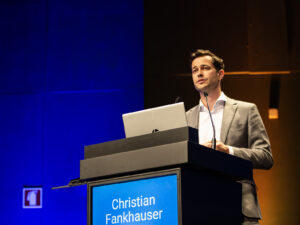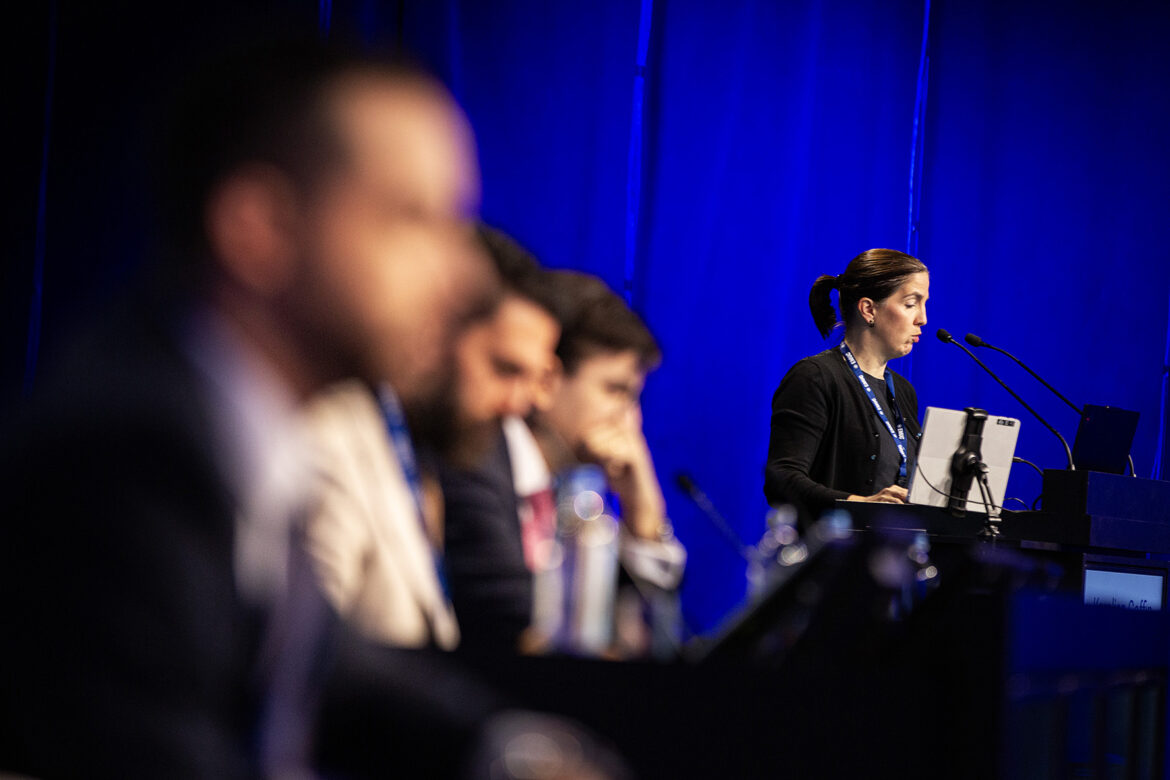
Plenary Session 1 “Individualised treatment in advanced prostate cancer” kickstarted with a clinical case presented by urologist Prof. Juan Gómez Rivas (ES). Led by Chairs urologists Prof. Giorgio Gandaglia (IT) and medical oncologist Dr. Pasquale Rescigno (GB), the session provided multidisciplinary perspectives on factors to consider for treatment individualisation.
The case
In November 2023, a 69-year-old patient (ECOG 0) was diagnosed with prostate adenocarcinoma (Gleason 4+5, PSA 146 ng/mL), with pelvic lymph node involvement and eight bone metastases, but no visceral disease.
He received first-line triplet therapy with androgen deprivation therapy (ADT), six cycles of docetaxel and darolutamide, achieving an excellent response (PSA nadir 0.08 ng/mL), with nodal regression and stable bone disease on serial imaging.
ADT and darolutamide were subsequently continued for over two years. Now aged 72, the next treatment decision is approaching.
After more than two years of treatment, the patient showed signs of disease progression, with PSA increasing from 8.4 to 19.6 ng/mL within three months, despite castrate testosterone levels (18 ng/dL).
CT imaging revealed new retroperitoneal lymph nodes, while bone scintigraphy identified two new lesions. No visceral metastases were detected.
The patient remained fit and independent (ECOG 0), with persistent grade 2 sensory neuropathy, controlled hypertension and moderate renal impairment (eGFR 55 mL/min/1.73 m²). Tumour and germline testing have not yet been performed.
Viewpoints from some of the experts
During her lecture “New imaging techniques”, nuclear medicine physician, Dr. Karolien Goffin (BE), highlighted the importance of imaging in selecting patients for 177Lu-prostate-specific membrane antigen (PSMA) radioligand therapy (RLT). Patient selection requires PSMA PET positivity, with no mismatch between PSMA and fluorodeoxyglucose (FDG) imaging. In addition, imaging provides predictive and prognostic information through parameters such as mean PSMA uptake (SUVmean), PSMA-positive tumour volume (PSMA-TV), and FDG-positive tumour volume (FDG-TV).
In her presentation, “Molecular biomarkers” medical oncologist Dr. Elena Castro (ES) underscored the importance of identifying if patients have BRCA1/2 defects because it is associated with the prognosis. Only PARPi (+/-ARPi) have been demonstrated to improve overall survival. Advanced PCa with BRCA1/2 alterations should receive PARPi (+/-ARPi). Early use of PARPi is preferable to late use.
Dr. Castro added that for PALB2 gene alterations, the benefit is likely similar to BRCA. There is limited evidence due to low prevalence. With regards to CDK12 gene alterations, conventional therapies resulted in poor outcomes. PARPi + ARPi should be considered. For ATM gene alterations, there is potential benefit from PARPi + ARPi in mHSPC.
She emphasised the need to identify dMMR (deficient mismatch repair) and MSI-H (microsatellite instability-high) status and consider anti-PD-1/PD-L1 immunotherapy.
“For the clinical case discussed today, PTEN loss will not be an option. The evidence we have for therapies is for mHSPC. PTEN loss is also associated with poor outcomes,” said Dr. Castro.
She concluded, “Remember that in some cases, we may detect more than one biomarker in the same tumour and we need to choose which therapy to use.”
Oncologist Dr. Aurelius Omlin (CH) presented “Guidelines considerations” and concluded that prior mHSPC therapy drives the choice together with performance status (PS), symptoms, extent of disease, and genomic profile. He stated that sequencing of ARPI should generally be avoided.
Dr. Omlin added if there are no HRR alterations identified in patients after ADT + ARPI, docetaxel is the leading choice especially if they are symptomatic.
He said that after ADT + ARPI + docetaxel, 177Lu-PSMA-617 is preferred if PSMA PET-positive.
In case of HRR/BRCA alteration, ARPI + PARP inhibitor is the first-line standard. After ARPI in mHSPC, the Advanced Prostate Cancer Consensus Conference (APCCC) is split between PARPi combination and monotherapy.
Find out more expert perspectives regarding the case, and (re)view the full presentations via the EMUC26 Resource Centre.