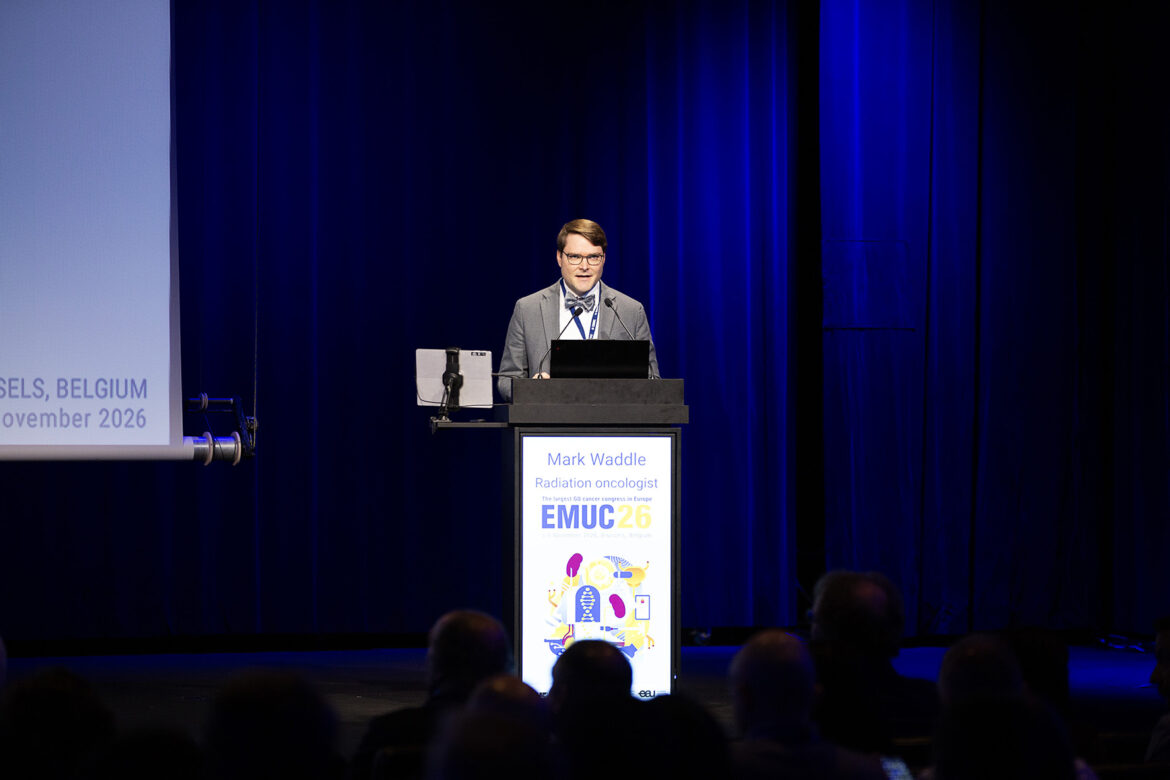
The Plenary Session ‘AI in GU cancers: Clinical partner or complex distraction?’ featured two keynote lectures, as well as a case discussion to illustrate real world challenges in artificial intelligence (AI), and rapid-fire debate on the use of large language models (LLM) LLMs for clinical decision making. The session was chaired by urologist Dr. Pieter De Backer (BE) and radiologist Dr. Maarten De Rooij (NL).
Radiation oncologist Dr. Mark Waddle (US) presented the first keynote lecture ‘AI in clinical and in literature review: what clinicians must know (but never delegate). He highlighted the growing complexity of clinical decision-making, with physicians having to consider increasingly larger amounts of information, from diagnostics and biomarkers to co-morbidities and patients’ personal priorities. He also noted that healthcare’s digital ecosystem has struggled to keep pace, with the communication of information scattered across multiple systems. “It can make helping a patient through a decision much harder than it was 20 years ago, so the question is will AI solve our problems?”
Dr. Waddle cited results from the AMA survey indicating that more than 80% of physicians are using AI in 2026. Approximately 40% use it to understand medical research or standard of care guidelines, but increasingly, about 30% are using AI for summarising and documenting.
According to Dr. Waddle, companies are investing in providing tools that are pushing the boundaries of what has been traditionally allowed in medicine. “It is more important now than ever to understand the impact that this technology will have on practice.”
He also referenced the ASTRO AI White Paper, which emphasises that the AI-enabled clinician of the future should be more coordinated, consistent and capable, but not less human. Ultimately, patients must stay at the centre of care, with complex judgement, accountability, empathy, and shared decision-making remaining with the clinical team.
Real-world examples of AI solutions
To demonstrate the potential of AI in medicine, he presented three real-world examples of AI solutions developed at the Mayo Clinic. The first, ‘The Daily Dose’, is an AI-generated email delivered at the start of each day, summarising scheduled patients and compiling their relevant information to help clinicians in preparing for their consultations. While it serves as a useful summarisation tool, human oversight remains essential, with all information verified by clinicians. On average, this tool is saving 11 to 13 minutes per user per day.
The second AI tool, ‘OncoTimeline’, is a patient and cancer specific interactive timeline with embedded AI and chat capabilities to support the review of clinical information. The third tool they have developed in their clinic is the ‘Prostate Cancer Control Tower’, designed to assist with follow-up and earlier detection of re-occurrence. It addresses key challenges of PCa follow-up, including the burden on physicians, patients being lost to follow-up and inconsistencies in adherence to clinical guidelines. The tool streamlines and personalises follow-up care, ensuring that patients are appropriately monitored. Notably, it has achieved a lead-time of seven months in detecting recurrence.
AI agents
Prof. Geert Litjens (NL) presented the second keynote lecture, ‘AI-supported imaging and pathology in GU cancers: ready for prime?’. He said, “Our research ambition is changing. In the past few years, we have largely trained narrow AI to reproduce tasks doctors already perform, such as detection and grading. Today, we are exploring narrow AI that extracts information beyond routine human assessment, including directly predicting outcomes from tissue. The next ambition is broader multimodal AI that combines complementary evidence and tools across the patient journey.”
When looking at future developments in AI for PCa, Prof. Litjens cited the abstract featured at EMUC26: CHIMERA-Agent: A multicentre benchmark of AI agents for sequential PCa decisions from biopsy to biochemical recurrence. This work builds on the original CHIMERA project, but with the objective to have a flexible agent that can handle realistic clinical conditions to support decision-making throughout the PCa pathway. It focuses on three key decisions: whether a patient should undergo a biopsy, whether a patient should receive active surveillance or definitive treatment, and predicting time-dependant biochemical recurrence. Its main innovation is agent-level reasoning, requiring AI to not only make predictions but also to explain how it integrates available evidence, handles missing or conflicting information, and reaches its conclusions under real-world clinical conditions.
What if AI and the radiographer disagree?
Radiologist Dr. Georgios Agrotis (NL) presented a case to illustrate the real-world challenges of implementing AI in prostate MRI. He emphasised that agreement between AI and radiologists does not always guarantee correctness, and if there is a disagreement between the two, it still does not identify which is right. “Prospective clinical validation and continuous monitoring are therefore essential before routine implementation. The radiologist remains accountable for the imaging interpretation, working within a multidisciplinary decision-making process.”
You can (re)watch the full presentation of the Plenary Session on AI in GU cancers on the EMUC26 Resource Centre.