What matters in germline-somatic interplay and testing pathways in precision oncology?
Plenary Session 7 “Familial cancers: molecular diagnostics, management and follow-up” chaired by medical oncologist Dr. Niven Mehra (NL) and urologist Prof. Antti Rannikko (FI) featured clinical cases and rapid-fire discussions, as well as sessions on topics such as germline-somatic interplay and testing pathways in precision oncology. This report provides some of the expert insights and updates shared during the session.
In her presentation, “Germline–somatic interplay: what matters clinically? Focus on germline carriers of cancer predisposition genes in HRR pathway, Lynch Syndrome, Biallelic loss in tumour, HRD phenotype, treatment implications”, Prof. Marjolein Ligtenberg (NL) concluded that individuals with germline BRCA1/2 or MMR gene pathogenic variants have a higher chance of developing a homologous recombination deficient or MSI tumour. Not all tumours of these individuals have an inactivated 2nd allele; they are not as sensitive to PARP inhibitors or immunotherapy.
Prof. Ligtenberg underscored that therapy selection should be guided by tumour testing rather than germline testing alone. She also added that assessing the impact of biallelic inactivation is informative in patients with Lynch syndrome (MSI), but appears to be less specific in patients with pathogenic variants in HRR genes (GIS).
Germline testing is advised tumour testing identifies a BRCA1, BRCA2, PALB2 PV or MSI as the variant may be germline-derived. Identifying an inherited predisposition is important because it can guide actionable measures to reduce cancer risk, including cancer prevention.
Testing pathways in precision oncology
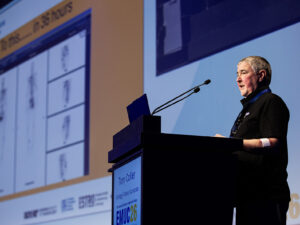
During the segment “Testing pathways in precision oncology: Germline, tumor, or both. How do you test today?”, urologist Prof. Juan Gómez Rivas (ES) presented “Germline testing early and broadly” wherein he underscored that germline testing should be performed early in the treatment pathway, as it can guide patient management and identify inherited risks that may have implications for the entire family.
Prof. Gómez Rivas also briefly discussed the PROCLAIM trial, which included 958 patients with prostate cancer who were not specifically selected based on particular characteristics or testing criteria. Overall, 7.7% of patients were found to carry a pathogenic or likely pathogenic germline variant following germline testing. Notably, 42% of the patients identified with pathogenic or likely pathogenic germline variants did not meet the 2019 NCCN criteria for germline testing and would therefore have been missed if testing had been restricted to patients meeting these criteria.
He highlighted, “If we’re always focusing on those who are or might be positive, we risk missing patients who may have these mutations.”
In her presentation “Practical implementation: can we scale germline testing”, medical oncologist Dr. Elena Castro (ES) said that the characteristics of germline mutation carriers remain undefined. She added that family history of cancer is the best predictor of a germline mutation. However, up to 30% of carriers are without a known family history of cancer. Screening is recommended.
Dr. Castro explained that the recommendation to maximise patient screening coincided with the expansion of genetic testing guidelines across multiple tumour types. Furthermore, there is a shortage of genetic consulting services. Clinicians may lack skills or knowledge for pre-test counselling. So what can be done?
She concluded by discussing the algorithm below, which was derived from the Canadian Urological Association Guidelines.
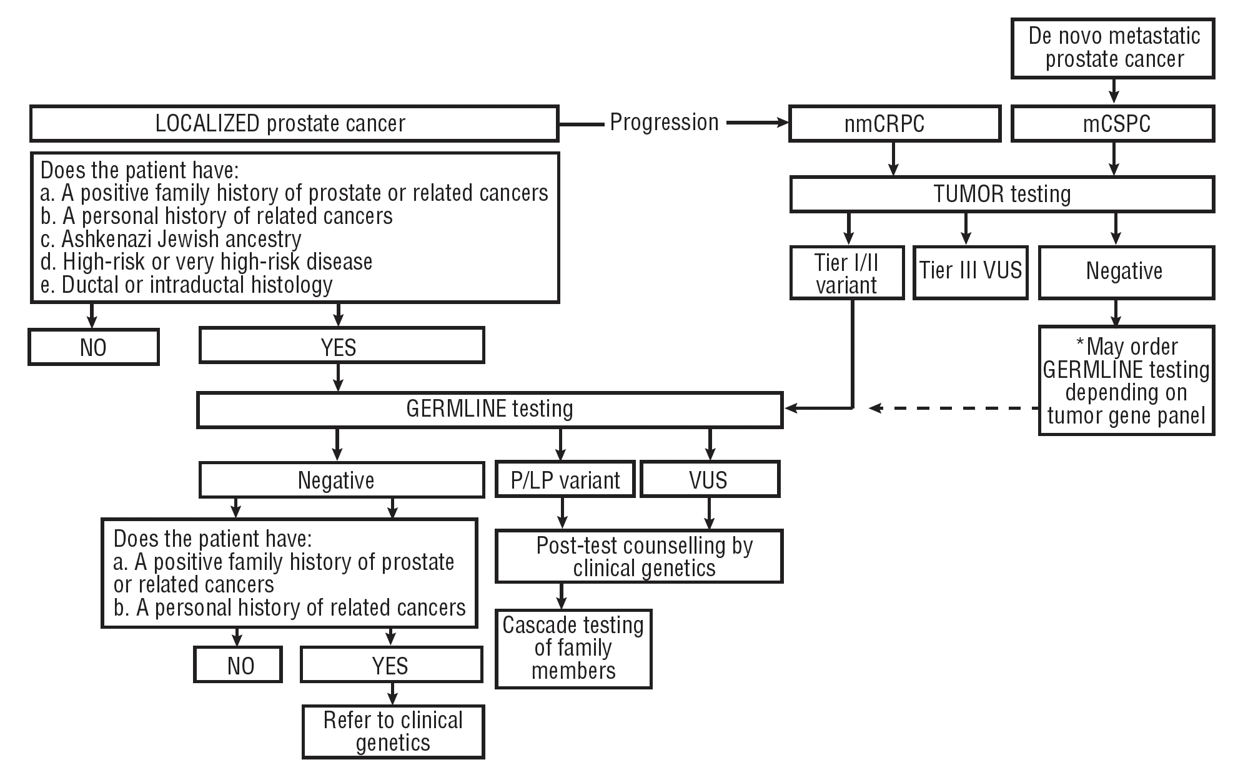
Rendon et al, Canadian Urological Association Guideline, Can Urol Assoc J, 2023
(Re)view the full versions of the presentations above, and watch the other presentations in Plenary Session 7 via the EMUC26 Resource Centre.