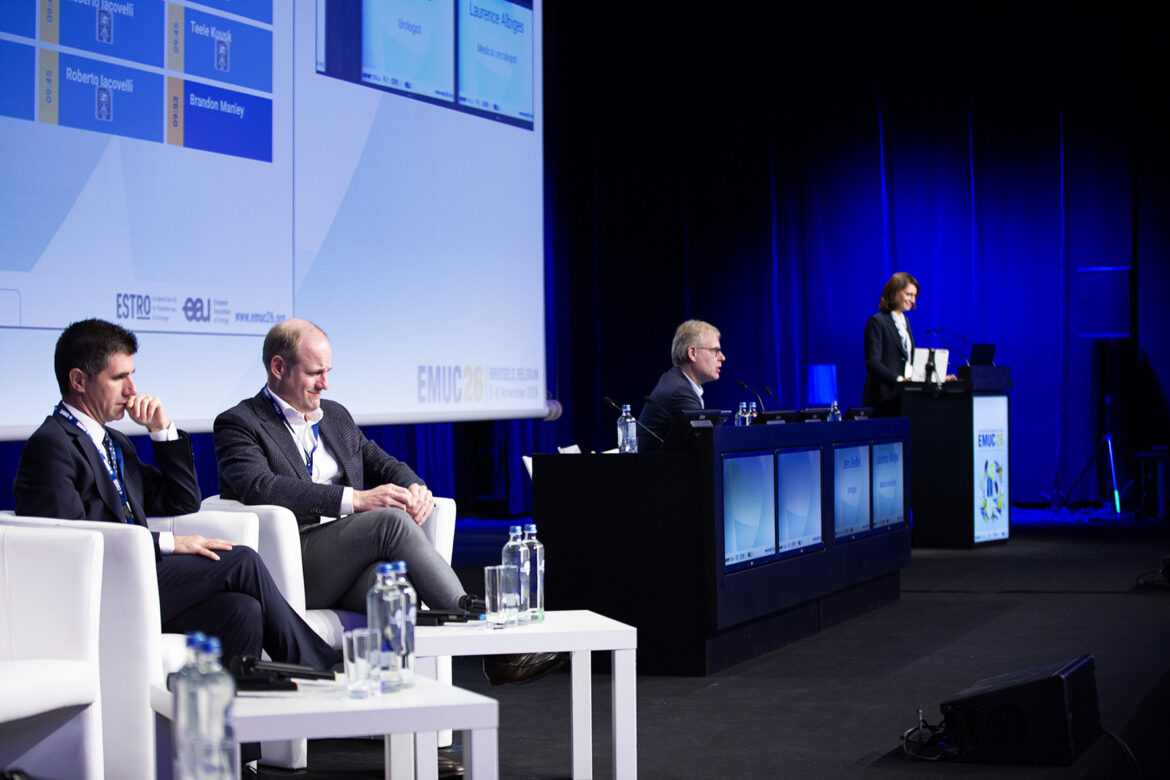
Day 4 of EMUC26 kicked off early with Plenary Session ‘Renal cancer: Local and systemic treatment in metastatic disease’, which was chaired by medical oncologist Prof. Laurence Albigies (FR) and urologist Prof. Jens Bedke (DE). The session included discussions on the evolving treatment landscape for first-line systemic therapy, radiotherapy for oligometastatic, treatment after adjuvant therapy, followed by debates and multidisciplinary case discussions.
Oligometastatic RCC: A stage-adapted treatment approach
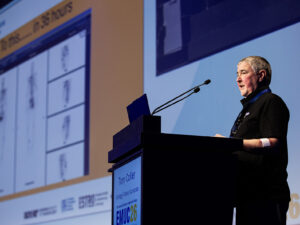
In his lecture on ‘Radiotherapy for oligometastatasis: different trials for different stages?’, radiation oncologist Prof. Ben Vanneste (BE) stated that oligometastatic kidney cancer is not a single clinical entity, it is a spectrum. He began his presentation by distinguishing the different settings in oligometastatic disease, ranging from synchronous and metachronous systemic therapy-naïve oligometastatic disease to oligoprogression during systemic treatment and the broader metastatic setting in which radiotherapy has been combined with systemic treatment. This distinction between clinical scenarios is essential, as the rationale, treatment objectives and potential benefits of SABR differ according to the stage and evolution of metastatic disease.
Prof. Vanneste highlighted that radiotherapy is an option for local treatment of RCC, stating that “if you can give a sufficiently high dose, you can destroy an RCC”. He noted that there is now sufficient prospective evidence to support this approach, with modern SABR achieving local control rates of over 90%. Furthermore, SABR offers a non-invasive treatment option, avoiding complications such as bleeding and infection associated with invasive procedures. Prof. Vanneste stated that SABR has largely solved the local control problem, however, the unanswered question remains whether controlling a limited number of lesions meaningfully changes the patient’s overall treatment trajectory.
According to Prof. Vannese, in systemic therapy-naïve patients with oligorecurrence, SABR can achieve durable local control of metastatic lesions and potentially defer the initiation of systemic therapy. In patients with oligometastatic disease, SABR may eradicate the primary tumour and all visible metastatic disease, in combination with systemic therapy, potentially addressing both macroscopic and residual micrometastatic disease. In the setting of oligoprogression, SABR can target resistant lesions, allowing patients to prolong the benefit of their ongoing systemic treatment. Overall, SABR may also delay the initiation of systemic therapy in carefully selected patients, supporting a personalised, disease-stage-adapted approach to the management of oligometastatic RCC.
Treatment after adjuvant therapy
Oncologist Assoc. Prof. Roberto Lacovelli (IT) presented the lecture ‘Treatment after adjuvant therapy’, highlighting that “despite adjuvant therapy, approximately 40% of patients experience recurrence within five years after surgery for localised RCC, and about 15% progress while receiving adjuvant IO.” He said that patients will refractory disease or early progression should not routinely be re-exposed to IO-based combinations. The same approach may be considered for patients with intermediate progression (up to 6 months). In these settings, cabozantinib or lenvatinib plus belzutifan are his preferred treatment options.
“There is no established standard of care for patients progressing beyond these time points. VEGFR-TKI is recommended, although VEGFR-TKI plus IO combinations may also be reasonable. Prospective evidence is needed”. According to Assoc. Prof. Lacovelli, future studies should focus on this clinical setting to investigate novel combinations and better define the role of IO rechallenge.
You can watch the full plenary session on GU Cancer Survivorship in the EMUC26 Resource Centre.